I've been writing this blog now for several years and the most common email I get is always about effusion lamps. I know why-they can be tricky. The wicks burn out, clog up or the scent doesn't smell up the house, etc, etc. I've done so much research on these lamps that I really feel I finally know what I'm talking about.
I was surprised to get an email from Carol a few weeks ago. She was having some problems with her effusion lamp and needed some advice. She surprised me by mentioning a new wick that she is using-which I had never heard of. I seriously don't even know how long the have been around. These wicks have no stone either...... hummmmmmmm......this is soooo interesting. It starts instantly, which saves on fuel, and eliminates the 5 minute (sometimes scary) lighting of the stone. Called the "Platinum Wick", it can't clog or flood. It fits all types of effusion lamps and retails for about $14.95, depending on where you look. My only question would be: how long will it last? I can't answer this yet, but I will let you know.
I ordered mine from here because the price was right and they offered free shipping. I've had it for two weeks and I burn it everyday, so we'll see how it goes. Below are some step by step photos and a good look at the wick.

To start off: here is the wick, right out of the box.
Below is the lamp filled 1/2 up with fuel. Remember, don't fill over 1/2 way up-these lamps need oxygen to work. Pop in the wick and leave it for 10 minutes.


Above: the wick. Looks like something that goes over a chimney. Notice there is no stone with these new wicks. The stone is replaced with a metal grate that heats up during the process.
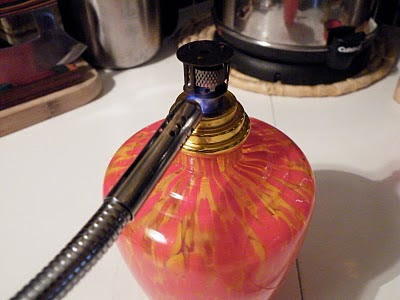
Here is the wick being lit.
Here is the flame that is created. You keep the wick lit for 30-35 minutes, a little flame appears for a few seconds and then you blow it out! The metal grate gets hot and the smell starts almost immediately. It's a big difference from the old stone wicks. I still like them and use them, but this new one appears much safer to use.
So there you have it. A new type of wick for the effusion lamps.
Here is my original post on effusion lamps which includes history, information and the fuel recipe.
FYI-I have purchased so many nice and inexpensive effusion lamps at this store in the local mall. Check their site and see if there may be one by you.







 One of the greatest surprises during my California adventure was coming across a little known Frank Lloyd Wright house in Carmel directly across Monterey Bay from Pebble Beach.
 While I agree with many other architects that Frank Lloyd Wright is overly regarded in general, one can't help but admit he was a tremdendously talented architect.
 The Walker Residence was designed in 1948 and completed in 1951 for Della Walker. It's a small house nestled into the beach rocks on the water side of Scenic Drive in Carmel. I loved the gates into the driveway / carport which almost feel like the backdoor as it has such a prominent face on the other side.
 As you can tell from these pictures, it's so perfectly sited that it blends into its surroundings. If you didn't know it was there, you might not notice it!
 It's small sizes gives it the nickname 'the cabin on the rocks' (Carmel is full of cottages or 'cabins') but it's definitely not small on design. Above you see a typical FLW element, the carport.
 Built originally for $125,000, FLW later added a master bedroom in 1956. He is known to have considered this amongst his favorite houses.
 I would compare the siting of the house and its relationship to the water with Fallingwater. FLW took a beautiful piece of property and only improved it with his design.
 The one side of the house has stairs which go down onto a small secluded beach area, seen above.
 The design is based on a ship with a terrace off the liviing room becoming the prow, thrusting into Monterey Bay.
 Such an elegant house and I love the stonework.The plantings on this side of the house look native to the area and really feel a part of the house itself.
  The house was featured in the 1959 movie "A Summer Place". Has anyone ever seen this? I'll have to add it to my netflix queue.
 A few of you asked for some pictures of actual plants from the National Bonsai museum at the National Arboretum rather than the architecture. I'm happy to oblige but I'm sorry to say I don't know much about them (other than they were pretty amazing)!
 The twisted and gnarled trunk of this tree caught my eye. I love the shiny leaves as well for their contrast.
 This trunk seemed to be forming a Trojan hourse: doesn't it look like a statue? Amazing.
 One more sculptural tree trunk. Keep in mind these bonsai are generally around 12-24" tall.
 A weeping coniferous bonsai.
 My absolute favorites were the ones which formed miniature forests.
 This grouping was the most successful: moss as grass and tiny pebbles as a path. You can just imagine a gnome walking through at any moment!
 Not all of the plants were in miniature. At the entrance to the bonsai garden was this huge flowering vine. I think the bees were enjoying it as much as we were!


